

Fascia according to the approach
Health as a Whole
Fascia is more than just a tissue to be familiar with.
It serves as a gateway to understanding the body as a living, intelligent, and interconnected system—where structure, respiration, fluids, function, and adaptation are closely intertwined.
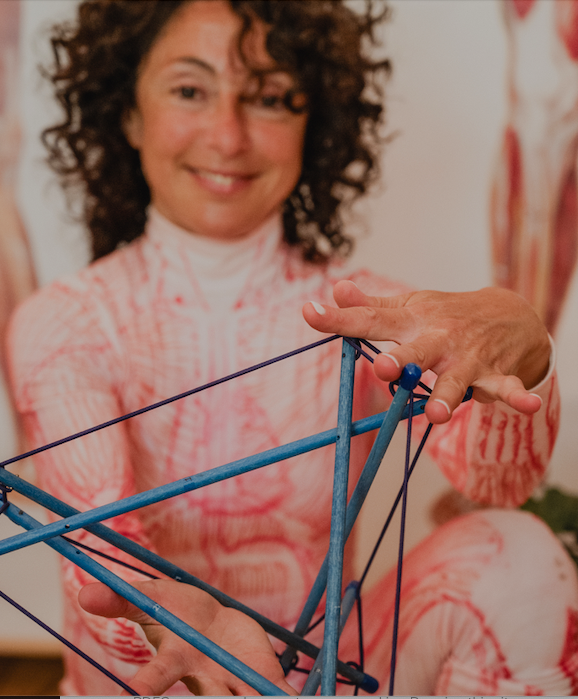
At Yoga ReSource, fascia is not treated as an isolated topic or merely an anatomical trend. Instead, it serves as a guiding principle for better reading the body, understanding overall health, and guiding movement with greater precision, meaning, and effectiveness.
In the Health as a Whole developed by Carina Raisman, the body is not viewed as a sum of separate parts. It is understood as a set of vital functions that collaborate, communicate, and influence one another. This is where fascia becomes particularly revealing: it helps us understand the connection between form and function, between breathing and posture, and between the quality of the tissues and the quality of adaptation. This perspective aligns with the way Yoga ReSource already presents its holistic approach and professional training.
This page outlines the key points of this vision and provides resources for exploring it in greater depth.

Want to get the basics down before diving deeper?
→ Read the article What is fascia?
Why is the fascia a gateway to understanding the body in a new way?
Fascia invites us to see things differently.
Instead of seeing only muscles, joints, or painful areas, it helps us perceive a network of continuity, transmission, and organization. It reminds us that what happens in one part of the body does not always remain localized. Tension, restriction, compensation, a change in breathing, or a loss of fluidity can have repercussions far beyond the place where they occur.
From this perspective, understanding the fascia means gaining a better understanding of:
why the whole body is involved in the movement;
why breathing affects much more than just the lungs;
why the quality of the tissues affects the quality of function;
and why sustainable health often requires integration rather than fragmentation.
The 5 principles that underpin the Health as a Whole approach
Understanding fascia better—
—means understanding better how the body maintains its health
How does this approach manifest itself
in the living body?
-

Breathing and the Nervous System
La respiration n’est pas seulement un échange d’air.
Elle influence la posture, le tonus, la perception, la sécurité interne et la capacité du corps à s’autoréguler.
C’est d’ailleurs un axe déjà central dans l’offre de Yoga ReSource, autant dans l’atelier fascia que dans la formation 250h. -
Posture, Movement, and Adaptation
Posture is not a static image that needs correcting.
It is often the expression of an organizational strategy.
Observing the fascia means learning to interpret tensions, compensations, densities, shifts, and areas that speak for others in a different way. -

Tissue hydration, gliding, and resilience
When tissues become more supple, mobile, and responsive, the body often regains greater fluidity, mobility, recovery, and ease.
This vocabulary—hydration, mobility, regulation, tensegrity, tissue observation—is already part of the current educational language of the fascia workshop.
Learn more
Here are some resources to help you explore this approach from different angles.
Moving from understanding to experience
Understanding fascia in theory is already valuable.
Feeling it, observing it, living with it, and learning to work with it transforms the practice even further.

Workshop — Fascia, Form & Fluidity
This workshop offers a practical introduction to exploring the connection between fascia, breathing, regulation, tissue hydration, micro-movements, and myofascial release.
It helps integrate theory into the body, into asanas, into walking, and into everyday movements.
The current offering also highlights, for the more professional track, tissue gliding, tensegrity, tissue observation, and therapeutic sequencing.

250-Hour Training Program — Therapeutic Yoga: Health as a Whole
The 250-hour training program is designed for yoga teachers, therapists, and healthcare practitioners who wish to develop a deep understanding of the body and its interconnected systems in order to guide others toward lasting, holistic health.
In particular, it emphasizes anatomy and alignment, postural assessment, physiology, the nervous system, breathing, fascia, functional biomechanics, the identification of compensations, and precise adaptation.
Carina doesn’t just offer instruction in techniques or the accumulation of information.
She offers a way of thinking about and experiencing the body that bridges medical science, the philosophy of yoga, and somatic experience.
It is this coherence that makes the Health as a Whole approach Health as a Whole profound, practical, and applicable to real life—both for living more fully in one’s own body and for better supporting others.
What our students have to say
Yoga ReSource is a member of the Association des Naturopathes et Naturothérapeutes du Québec and is recognized as a training school.
This affiliation reinforces the quality and legitimacy of our programs and contributes to the eligibility of our graduates to issue naturotherapy insurance receipts.


✺ FAQ ✺
-
Fascia is a continuous tissue found throughout the body. It envelops, connects, supports, and organizes the body’s various structures. In the Health as a Whole approach, it helps us understand the body not as a collection of separate parts, but as a living whole in which structure, respiration, fluids, movement, and function are intimately interconnected.
-
Because it plays a role in the quality of tissue interactions, the transmission of forces, the circulation of fluids, and the coordination of movement. When we gain a better understanding of the fascia, we also gain a better understanding of why tension, restriction, or compensation can have broader effects than expected.
-
In this approach, breathing affects much more than just the lungs. It also influences the body’s structure, the quality of movement, muscle tone, homeostasis, and the sense of inner readiness. The fascia helps us understand these connections in a more holistic way.
-
Here, posture is not viewed as a rigid form to be corrected, but as an expression of the body’s structure. Observing the fascia allows us to interpret tensions, shifts, compensations, and the way the body adapts in a different light.
-
They are designed for people who are curious to better understand their bodies, as well as for yoga teachers, therapists, and practitioners who wish to refine their perspective, their practice, or their approach to supporting others.
-
No. Movement is an important entry point, but the fascia also helps shed light on the connections between posture, breathing, circulation, perception, regulation, and adaptation.
-
Because these concepts help provide a more nuanced description of the body’s organizational structure. They allow us to move beyond an overly mechanical or simplistic interpretation and toward a more dynamic understanding of how the body functions.
-
Because gaining a deeper understanding already changes the way we feel, move, observe, and support others. And when that understanding is then rooted in experience, learning becomes much more lasting.
-
Carina does not present fascia as merely an anatomical topic. She uses it as a gateway to connect anatomy, physiology, breathing, posture, adaptation, and bodily experience. Her " Health as a Whole " approach Health as a Whole an interpretation that is precise, holistic, and embodied.
-
Yes. The approach can be made very accessible, even for those without a technical background. Carina uses a lively, practical, and step-by-step teaching method that helps students grasp and understand the concepts before moving on to more complex topics.
-
The workshop is an excellent introduction to discovering, sensing, and practically experiencing these principles through the body and movement. The 250-hour training program goes much further: it allows you to integrate this understanding into a deeper appreciation of the body, breathing, functional biomechanics, and therapeutic yoga practice.
-
No. Depending on the format you choose, some introductory courses are open to a wider audience. The workshop may be suitable for those who wish to explore these concepts in a practical and engaging way. The 250-hour program, on the other hand, is geared more toward those who want to deepen their understanding, provide guidance, or professionalize their approach.
-
If you’re looking for a hands-on introduction, start with the Fascia, Form & Fluidity workshop. If you’re seeking a more comprehensive training program to transform your understanding of the body and your coaching approach, the 250-hour program is the most in-depth option.
-
The Health as a Whole " approach Health as a Whole multiple levels of understanding. It is grounded in a solid understanding of anatomy and physiology, while placing great emphasis on lived experience, keen observation, and an understanding of the body in motion.
-
It can provide valuable insights for better understanding the body, its structure, and certain coping strategies. While it does not replace medical advice when needed, it can enhance our approach to movement, breathing, and support.

About Carina Raisman
B.Sc, Yoga Therapist, E-RYT500, ANQ, RITMA
Founder and visionary of Yoga ReSource
Carina Raisman has been a yoga therapist and instructor for over 20 years. With a bachelor's degree in microbiology and immunology (McGill) and training in pharmacology, homeopathy, and herbal therapies in Montpellier, France, she uniquely combines biomedical science and modern yoga therapy.
Her expertise covers:
functional biomechanics,
breathing and modulation of the autonomic nervous system,
the parasympathetic posture and the regulation of persistent cases.
Today, Carina is dedicated to bridging the gap between modern medicine and yoga therapy.
Through research, interdisciplinary collaboration, and clinician training, she works to integrate the principles of therapeutic yoga into the healthcare system, making this approach accessible, effective, and sustainable.
As the head of Yoga ReSource—School & Clinic of Therapeutic Yoga, Carina imparts a grounded, precise, and deeply human approach to teaching. Her teaching emphasizes alignment, respiratory function, modulation of the nervous system, and the art of guiding the body toward its natural healing potential.
Enrich the pathway to your Certification
-
A la Carte Training
A solid foundation in therapeutic yoga.

-
Continuing Education
Options to refine, deepen and evolve at your own pace.
